

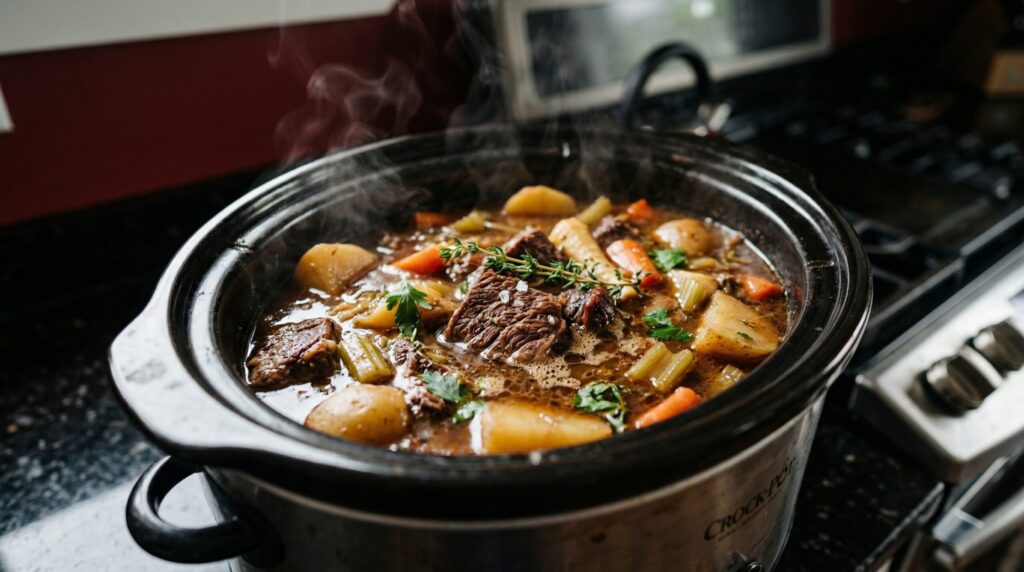
The short answer
- Fully cooked food on a working warm setting stays above 140°F, so bacteria are not the main worry overnight.
- Crock-Pot’s instruction manuals advise against using warm for more than 4 hours. A full night runs well past that.
- After 8 or more hours on warm, most food dries out, sticks to the crock, and turns mushy.
- Never use warm to cook raw food or to reheat cold leftovers. It isn’t hot enough for either job.
- The better plan is to time the cook so it finishes near morning, or to portion the food into shallow containers and refrigerate it.
In this post
- Is it safe to leave a slow cooker on warm overnight?
- How long can food stay on the warm setting?
- What happens to food after a whole night on warm?
- How do you know your warm setting is hot enough?
- What’s a better plan if you need food ready in the morning?
- How do you put away a full slow cooker at night?
- Is it a fire risk to leave a slow cooker on while you sleep?
- Slow cookers that switch to warm on their own
- Frequently asked questions
Yes, you can leave fully cooked food in a slow cooker on warm overnight without making anyone sick, as long as the warm setting keeps the food at 140°F or higher. It’s just not what the warm setting was designed for, and your chili will show it by morning.
With holiday cooking picking up this November, plenty of people are planning big batches and overnight cooks. Here’s where the safety line sits and how to plan around it so breakfast-time stew still tastes like stew.
Is it safe to leave a slow cooker on warm overnight?
It’s safe if the food was fully cooked before you switched to warm and the setting holds it at 140°F or above. The USDA treats 40°F to 140°F as the danger zone where bacteria multiply fast, and hot food held above that range stays out of it.
Most warm settings are built to sit above 140°F, but “most” is doing a lot of work there. Older cookers and units with tired heating elements can run cooler, and a nearly empty crock behaves differently than a full one. If you’ve never checked yours, you’re trusting a label on a dial.
How long can food stay on the warm setting?
The manufacturer answer is about 4 hours. Crock-Pot’s instruction manuals say not to use warm longer than that, because the setting is meant to bridge the gap between when food finishes and when you eat it. An overnight stretch is usually 8 to 10 hours, more than double the limit.
That 4-hour guidance is mostly about food quality and how the appliance is meant to be used. Food doesn’t turn dangerous at hour five if it’s still above 140°F. But once you go past the instructions, any problem is on you, not the maker.
What happens to food after a whole night on warm?
It overcooks. Warm still applies heat, so over a full night the liquid evaporates, the edges of the crock brown and stick, and meat that was tender at dinner goes dry and stringy.
Beans and potatoes break down into paste. Pasta and rice turn to mush, and cream or cheese sauces can split or scorch along the sides.
Brothy soups and big pots of chili hold up best because they have liquid to spare. Lean chicken breast holds up worst.
How do you know your warm setting is hot enough?
Test it with water and an instant-read thermometer. Fill the crock about halfway to two-thirds with water, heat it on low until it’s hot, switch to warm, and check the temperature after a couple of hours.
You want a reading at or above 140°F, and more margin is better. Lift the lid quickly and measure in the center, since an open lid drops the temperature fast.
If it reads below 140°F, don’t use that cooker for long holds on warm at all. That goes for a 3-hour party buffet too, not just overnight.
What’s a better plan if you need food ready in the morning?
Time the cook so it finishes close to when you need it, which keeps warm time short. A programmable cooker handles this for you: set 8 hours on low at 10 p.m., and it drops to warm on its own at 6 a.m.
Don’t use a plug-in outlet timer to delay the start on a manual cooker. Raw meat sitting in the crock at room temperature for hours before the heat kicks on is the real food safety risk, much bigger than anything the warm setting does.
Size matters for timing too, since a packed crock heats slower than a half-full one. If a holiday bird is part of the plan, check whether a turkey will fit in a 5 quart slow cooker before you build a schedule around it.
How do you put away a full slow cooker at night?
Turn it off, portion the food into shallow containers, and get it in the fridge within 2 hours. That’s the USDA’s standard for cooked leftovers, and shallow containers matter because a full crock cools so slowly the center can sit in the danger zone for hours.
Don’t put the whole stoneware insert in the fridge. Ceramic can crack from sudden temperature changes, and that dense mass of hot food warms everything stored around it.
Anything you won’t eat within a few days belongs in the freezer. The same vacuum sealer you’d use for deer meat works fine on flat-frozen portions of stew or pulled pork.
When you reheat, bring leftovers to 165°F on the stove or in the microwave. Don’t reheat them in the slow cooker, because it climbs through the danger zone too slowly.
Is it a fire risk to leave a slow cooker on while you sleep?
The risk from a cooker in good condition is low, because slow cookers are designed to run unattended for long cooks. What raises it is a frayed cord, an extension cord, or a cooker pushed tight against a wall or tucked under a cabinet.
Plug it straight into a wall outlet and give it a few inches of clearance on every side. Keep paper towels and dish towels away from the base.
If it ever smells hot or burnt, unplug it and inspect it before you trust it again. The same logic applies to any heating appliance, as with a space heater that smells like burning.
Slow cookers that switch to warm on their own
If your current cooker is a manual dial, a programmable model is the cleanest fix for overnight cooking, since it ends the cook on schedule and keeps warm time short. These are worth a look, and you can browse more kitchen picks in our deals hub.
Crock-Pot Programmable 7-Quart Slow Cooker
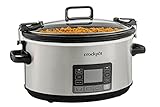
A 7-quart programmable cooker for families who start dinner before bed or before work. It drops to warm when the timer runs out, so the food isn’t sitting on warm all night. The locking lid also helps if that chili is headed to a potluck.
- Programmable timer that switches to warm
- Locking lid for transport
- 7-quart capacity feeds 9+
Crock-Pot Cook and Carry 4-Quart Programmable Slow Cooker

A smaller 4-quart oval for couples or small households, where a 7-quart crock would run half empty. The digital countdown shows how much cook time is left, and it moves to warm when the cook ends. Removable stoneware goes in the dishwasher.
- Digital countdown display
- Locking lid and side grip handles
- Dishwasher-safe removable stoneware
Crock-Pot 7-Quart Slow Cooker with Sous Vide and Probe

For the cook who wants to stop guessing by the clock. The removable temperature probe lets you cook meat to a target internal temperature, which matters most for roasts and poultry. It also has a sous vide function if you want a second use out of the counter space.
- Removable temperature probe
- Sous vide function
- Locking lid, 7-quart capacity
Frequently asked questions
Can you leave a Crock-Pot on warm overnight?
The same rules apply, since Crock-Pot is a brand of slow cooker. Fully cooked food that stays above 140°F is safe, but Crock-Pot’s manuals advise against using warm for more than 4 hours. Expect drier, mushier food after a full night.
I fell asleep and left food on warm all night. Is it safe to eat?
If the food was fully cooked and the cooker stayed on all night, it most likely stayed above 140°F and is safe, though the texture may suffer. If the power went out or the cooker was off for more than 2 hours, throw the food out. Reheating won’t fix food that sat in the danger zone.
Can you cook on low overnight instead?
Yes, that’s exactly what slow cookers are built for. Start with thawed ingredients, because frozen meat keeps the crock in the danger zone too long. A programmable model that switches to warm at the end is the best setup.
Can you put cold leftovers back in a slow cooker on warm?
No. Warm isn’t hot enough to bring cold food up to a safe temperature quickly. Reheat leftovers to 165°F on the stove or in the microwave first, then you can hold them on warm for serving.
So the honest answer is that warm overnight won’t usually hurt you, but it will hurt dinner. If the food is done before bed, put it in the fridge in shallow containers. If you want it hot in the morning, set the cook to finish when you wake up.
And if your holiday plans also involve a turkey sitting out overnight in something other than the fridge, the same 40°F line applies. Here’s how to brine a turkey in a cooler without guessing.