

Key takeaways
- Yes, Dawn kills adult fleas on contact. The surfactants break the water’s surface tension and strip the flea’s waxy outer layer, so fleas sink and drown instead of riding the water out.
- It only kills what’s in the tub. There is zero residual protection, so new fleas hop on within hours of the bath.
- Roughly 95 percent of a flea population lives in your carpet, bedding and floor cracks as eggs, larvae and pupae. A bath touches none of that.
- Dish soap strips skin oils. It’s fine as a one-time emergency wash, but it is not a shampoo and not a flea plan.
- The real fix is a vet-recommended flea product on the dog plus hot-water laundry and vacuuming at home, repeated for at least three months.
What’s in this guide
- Does Dawn dish soap really kill fleas on dogs?
- How does dish soap actually kill a flea?
- Is it safe to wash a dog with dish soap?
- How do you give a dish soap flea bath the right way?
- Why do the fleas come back the next day?
- What actually gets rid of fleas for good?
- Does the dish soap and water trap work?
- Frequently asked questions
Dawn dish soap really does kill fleas on dogs. Any adult flea that ends up in that soapy water dies, usually within a couple of minutes, and you’ll see them floating in the rinse. That part of the internet advice is true.
The part nobody mentions is that the killing stops the moment you drain the tub. There’s no residue left on the coat, nothing that stops the next wave of fleas hatching out of your rug, and dish soap does nothing to eggs or larvae in the house. Updated August 2026, right as flea season peaks in most of the country.
Does Dawn dish soap really kill fleas on dogs?
Yes, on contact, and only on contact. A thorough lather that sits on the coat for several minutes will kill the adult fleas currently on your dog. Wildlife rescue crews have used the same soap for decades to clean oil off birds, which tells you how well it cuts through waxy, greasy coatings.
What it can’t do is prevent. It leaves no insecticide behind, no growth regulator, nothing. Your dog walks out of the bathroom flea-free and back onto a carpet full of hatching eggs.
So the honest answer is that a dish soap bath is a knockdown tool, not a treatment. Useful in a pinch. Useless as a strategy.
How does dish soap actually kill a flea?
Two things happen at once, and neither one is poison. First, the surfactants in the soap collapse the surface tension of the water, so fleas that would normally float and scramble to the edge just sink. Second, those same surfactants dissolve the waxy cuticle that coats a flea’s exoskeleton and keeps water out.
Once that wax layer is compromised, the flea can’t stay dry or hold its breathing pores shut. It drowns. Plain water alone rarely does it, because fleas are built to shed water and grip hair.
This is why brand doesn’t really matter. Any grease-cutting dish liquid works the same way, and Dawn just happens to be the one everybody names.
Is it safe to wash a dog with dish soap?
Once in a while, on an otherwise healthy adult dog, it’s generally fine. Repeatedly, it’s not. Dish soap is engineered to strip grease off ceramic, and it strips the protective oils off skin and coat with the same enthusiasm.
What you tend to see after a few dish soap baths is flaky skin, a dull coat, and more scratching, which is confusing because you’re trying to stop the itching. Dogs with allergies, hot spots, or any broken skin from flea bites are the worst candidates. Soap in raw, bitten skin stings.
Keep it out of eyes, ears and mouth, use lukewarm water, and rinse far longer than you think you need to. If your dog already has coat issues after a summer of swimming, the same oil-stripping problem is at play in that damp dog smell after a lake day, and harsh soap makes it worse rather than better.
Puppies under eight weeks, senior dogs, and any dog that gets cold easily need extra care with the water temperature and drying. And cats are a different conversation entirely. Their skin is more sensitive and they groom off whatever you leave behind, so ask a vet first.
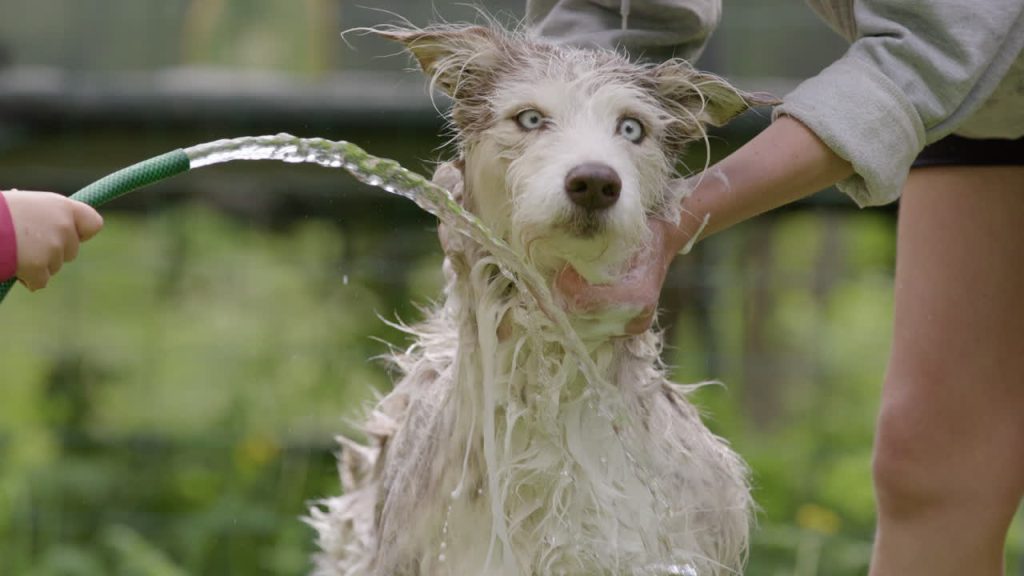
How do you give a dish soap flea bath the right way?
If you’re doing it anyway, do it once and do it properly. Speed matters less than contact time, since the soap has to sit on the fleas long enough to break down that waxy layer.
- Fill the tub with a few inches of lukewarm water before the dog goes in. Fleas flee toward the head, and a wet body gives them nowhere dry to run.
- Wet the neck and face area first with a damp cloth, working a soapy ring around the neck. This blocks the escape route toward the ears and eyes.
- Add a small squirt of dish soap to a cup of warm water rather than pouring it straight on the coat. Diluted lather spreads better and rinses out faster.
- Work it down to the skin everywhere, especially the belly, armpits, base of the tail and between the toes. Those are the crowded spots.
- Let the lather sit five minutes. This is the step people skip, and it’s the step that kills.
- Rinse until the water runs completely clear, then rinse once more.
- Towel dry, then run a flea comb through the coat and dunk the comb in a bowl of soapy water after every pass.
That last step catches the survivors and gives you a rough count of how bad the infestation is. A flea comb costs almost nothing and does more real work than most home remedies.
Why do the fleas come back the next day?
Because the fleas on your dog were never the main population. Adult fleas on a pet make up something like five percent of the total; the other 95 percent are eggs, larvae and pupae sitting in carpet fibers, sofa seams, floorboard cracks and the dog’s bed.
Flea eggs don’t stick to the dog. They roll off wherever your dog sleeps, walks and lies down, then hatch anywhere from a couple of days to two weeks later. Pupae are worse, because they can stay dormant in their cocoons for months and wait for vibration and warmth to trigger emergence.
So you bathe the dog, kill every adult flea, and by tomorrow morning a fresh batch has hatched out of the rug and hopped back on. Nothing failed. You just treated 5 percent of the problem.
What actually gets rid of fleas for good?
Two fronts at the same time: a real flea product on every pet in the house, and consistent cleaning of the environment for at least three months. Skip either one and you’ll be doing this again in September.
On the dog, ask your vet about a modern oral or topical preventive. The isoxazoline chews are prescription and work for a month or longer. Over the counter, nitenpyram tablets kill adult fleas within about half an hour, which is the closest thing to an emergency button, though they wear off within a day and are meant as a knockdown, not protection.
At home, vacuum every day for the first two weeks, including under furniture and along baseboards, and empty the canister outside each time. Wash all pet bedding and any washable throws in hot water, then dry on high heat. Heat is what kills eggs and larvae, so the dryer does more than the wash cycle, the same principle behind washing and drying fabric gear like backpacks when you need to actually sanitize them rather than just freshen them.
If the infestation has reached the carpet stage, a household spray labeled for fleas fills the gap that vacuuming leaves behind. Look for a product that lists an insect growth regulator, because that’s what stops eggs and larvae from becoming biting adults.
Ortho Home Defense Max Flea & Tick Killer

This is the kind of indoor spray you use on carpets, baseboards and furniture cracks after you’ve vacuumed, not on the dog. It’s meant to reach the larvae and pupae stage that a bath and a flea comb never touch. Read the label and keep pets and kids off treated surfaces until everything is fully dry.
- Indoor use on carpets, baseboards and furniture cracks
- Targets flea life stages a bath can't reach
- One gallon with applicator wand
Give it time. Even a perfect plan takes two to three months to clear a house, because dormant pupae keep hatching long after the adults are gone.
Does the dish soap and water trap work?
The shallow dish of soapy water under a nightlight does catch fleas, but treat it as a monitoring tool rather than a solution. Fleas are drawn to warmth and light, they jump toward the lamp, land in the water and drown for the same surfactant reason.
It’s genuinely useful for telling whether you still have an active infestation. Set one out in the room your dog sleeps in, check it each morning, and watch the count drop as your treatment works.
What it won’t do is meaningfully reduce the population. Only a fraction of the adults find the trap, and it does nothing about eggs. Use it as a thermometer, not a cure, and keep it somewhere the dog won’t drink from.
If you’re stocking up on flea and household supplies as the season turns, the current deals hub is worth a scan before you buy the first thing you see.
Frequently asked questions
How long does dish soap need to sit on a dog to kill fleas?
Give the lather about five minutes of contact with the skin before rinsing. Fleas die from the soap breaking down their waxy outer layer, and that takes a few minutes of sustained exposure. A quick lather and immediate rinse will miss a lot of them.
Does Dawn kill flea eggs and larvae on my dog?
It kills some eggs that get washed off in the water, but flea eggs mostly don’t stay on the dog anyway. They roll off into carpet, bedding and floor cracks within hours of being laid. That’s where the eggs and larvae need to be dealt with, and no bath reaches them.
Can I use dish soap on a puppy too young for flea medication?
Many vets do suggest a gentle bath and a flea comb for very young puppies who can’t take flea preventives yet, but call your vet first about your specific puppy’s age and weight. Chilling is a real risk with small puppies, so use lukewarm water, keep the bath short, and dry them thoroughly. A flea comb over a bowl of soapy water is often the safer option.
Is dish soap better than a flea shampoo?
No. Flea shampoos contain actual insecticides and are formulated for animal skin, so they kill more reliably and strip fewer natural oils. Dish soap only has the advantage of already being under your sink.
How often can I bathe my dog with dish soap for fleas?
Once, ideally. Repeated dish soap baths dry out skin and coat, which makes flea-bite itching worse rather than better. If you’re reaching for it a second time, that’s the signal to switch to a vet-recommended preventive and treat the house.
The short version: the dish soap trick isn’t a myth, it’s just badly oversold. It’s a one-time knockdown for a dog that’s crawling right now, at 11pm, when nothing else is open.
Do the bath if you need immediate relief, then spend the next morning on the parts that actually end the infestation. Vacuum, hot laundry, a real preventive from your vet, and patience through a few more hatch cycles.